How Do You Move a 50,000 lb Water Treatment Plant?

Moving a 50,000-pound containerized water treatment plant is easier than you might think. Learn how Laminar Water makes a rapid, cost-effective deployment possible.
Note: This post is a general introduction written by our marketing team and reviewed for technical accuracy by our engineers. For in-depth analysis of a specific technology or application, please contact our engineering team.
How do you move a mobile water treatment plant from one location to another?
When it comes to a Laminar Water system, the simple answer is this: you move it just like any other shipping container. No pilot cars, special permits, or oversized equipment required.
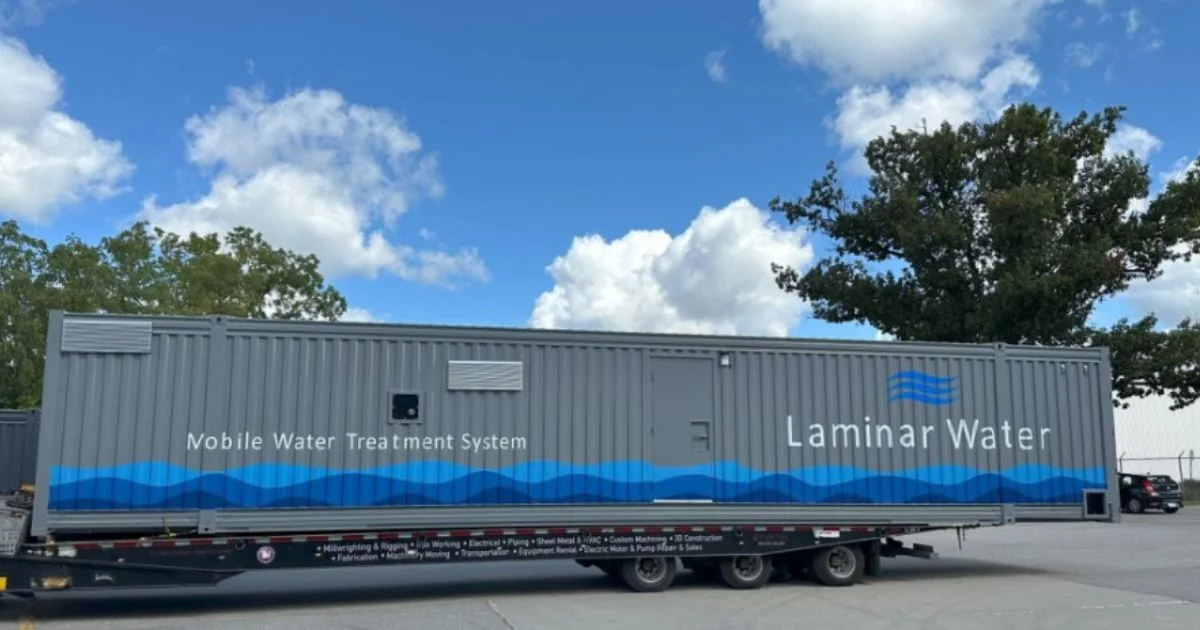
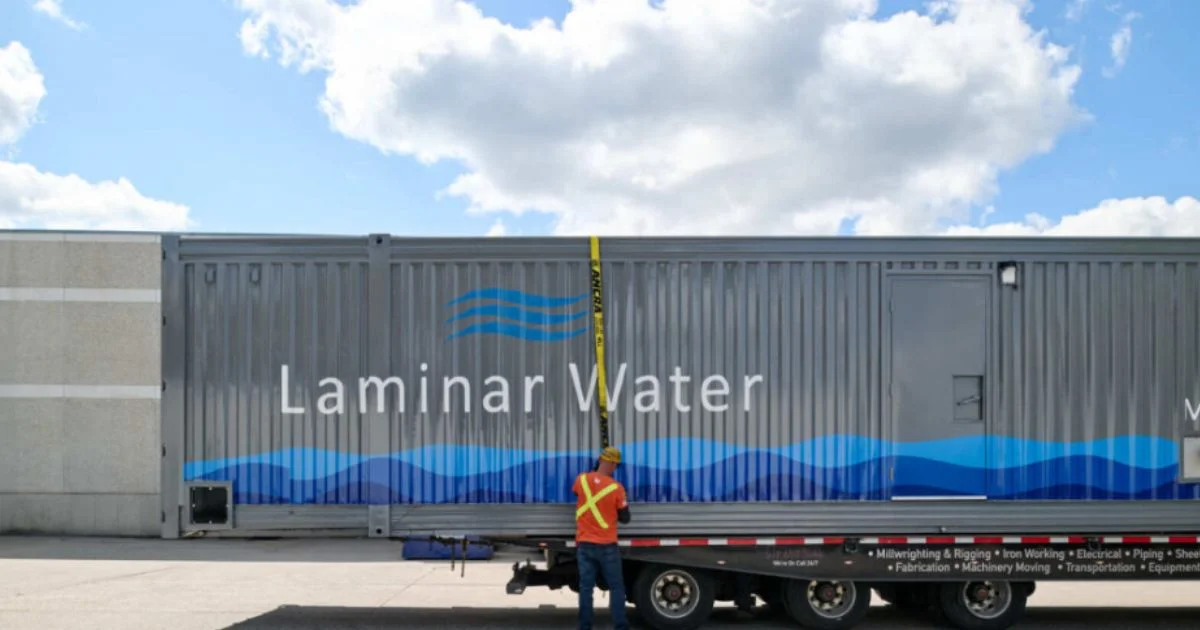
This simplicity is the result of an intentional design choice. Our systems are not cumbersome, oversized units that require disassembly for transportation. Rather, they are built within a standard 53-foot intermodal shipping container.
Most importantly, the entire process is managed by logistics professionals. Your team doesn't need to become transportation and craning experts; you just need to prepare your site.
Here are the steps involved with getting your Laminar Water system from our facility in Cambridge, Ontario, to your site anywhere in North America.
Transporting Your Containerized Water Treatment System
Our systems are built within standard 53-foot intermodal containers. The external dimensions are as follows:
Length: 53 feet (16 m)
Width: 8 feet 6 inches (2.6 m)
Height: 9 feet 6 inches (2.9 m)
Because the system fits these exact dimensions, it is not classified as an "oversize" or "wide" load. This means the unit can be transported on highways without requiring police escorts, special permits, or specialized (and costly) lag and lead vehicles. This "standard cargo" classification is what makes the entire deployment faster, simpler, and more cost-effective.
Being built to standard ISO shipping container dimensions also means it can be transported by road, rail, or sea.
For road transport, your Laminar Water system is typically moved using a container chassis, a type of tractor-trailer specifically designed to haul intermodal containers. The container itself is built with standardized, reinforced steel corner castings, and the trailer chassis is equipped with corresponding retractable twist locks. When the container is lowered onto the chassis, the driver or rigger inserts and rotates these twist locks to create a structural connection that is both faster and more secure than chains or straps.
When it comes to managing the delivery, you have two options:
Use Your Own Carrier: If you have an in-house fleet or a preferred logistics carrier, you are free to arrange the transportation.
Use Our Partners: We can also manage the process for you, using our own trusted logistics partners to safely deliver the system to your site.
If you choose to use your own carrier, you don't need to become a logistics expert. Simply describe the job: a 53-foot, 50,000-pound intermodal container. They will understand what is required and will dispatch the appropriate truck.
Lifting Your Containerized Water Treatment System
The delivery process involves two important lifts: loading the unit for transport and offloading it at your site.
We handle the loading process at our facility. The unit is jacked up, placed on industrial rollers, and moved into position. It is then lifted by a crane onto the trailer and secured by its twist locks.
For the final placement at your site, a mobile crane is required to lift the unit from the truck and place it onto the prepared concrete or gravel pad. You will need to hire a local rigging company for this final lift.
As with transportation, you don’t need to become a craning expert; you just need to describe the job to the crane company. Because the system is a standard intermodal shipping container, they will know exactly what to expect.
The company will send a crane operator to inspect your site before delivery day. They will assess the access route, ground stability, and check for any overhead obstructions that could pose a problem.
Your Role: How to Prepare for a Successful Delivery
While we and our logistics partners manage the move, your team's role is to ensure the site is ready. A prepared site means the truck and crane can arrive, perform the lift, and depart efficiently.
This preparation is important. Transportation and craning services often bill by the hour while they are waiting to unload, so if the site isn’t ready, it can lead to significant delays and extra costs.
As mentioned, the rigging company will perform a site inspection before the big day. During this inspection, they will be looking out for the items in this section.
Proper site preparation, of course, involves more than just clearing a path for delivery day. We cover the entire process, from foundation options (like concrete or compacted gravel) to utility hookups, in our post on site preparation.
For a smooth and efficient lift, here is what your team needs to have ready for delivery:
1. Clear Access Route
A 53-foot tractor-trailer requires a significant amount of turning space. Your site access road and entrance must be clear and wide enough to accommodate it. Be mindful that the trailer's rear wheels will follow a much tighter path than the front wheels. Site entrances and corners must be wide enough to prevent the trailer from running over curbs or soft ground.
2. Stable, Level Ground
The site for the plant itself (and just as importantly, the area where the tractor-trailer and mobile crane will set up) must be level, compacted, and stable. The ground must be able to support the weight of these heavy vehicles.
3. Sufficient Setup Space
For the lift to proceed safely, the delivery truck and mobile crane must be positioned side-by-side or in another approved configuration. Ensure there is a large, clear space that allows both pieces of equipment to operate without obstruction.
4. No Overhead Obstructions
The crane's boom needs a completely clear path free of obstructions such as:
Power lines
Communication cables
Tree branches
Building overhangs
What If I Need to Relocate the System?
A traditional water treatment plant is a sunk cost. When the site is no longer needed or its infrastructure becomes outdated, the multi-million-dollar plant is often decommissioned and demolished. Its value is gone.
One of the greatest benefits of a containerized water treatment plant is that it’s a mobile asset. If you ever need to relocate your water treatment plant, the process is just as straightforward as the initial delivery:
Decommission: The system is safely shut down and disconnected from local utilities.
Rigging & Transport: Just like on delivery day, a mobile crane is brought in to lift the unit from its foundation onto a standard container chassis.
Shipping: It can then be transported by road, rail, or sea as standard cargo; again, with no oversized permits or escorts.
Redeployment: The system can then be installed and commissioned at a new site, which has undergone the same simple site preparation.
There are many common reasons why you might need to move your system. For an industrial, mining, or construction site, the project may have a defined lifespan of 5 or 10 years. For a municipality, the plant might be a temporary solution while a larger, permanent facility is being built. Or it could be an emergency deployment for a community whose water treatment system has suddenly failed.
In all these cases, the ability to move, redeploy, or even resell the system means your investment retains its value. It’s not tied to a single piece of land; it goes wherever it’s needed most.
From Years to Days
A traditional water treatment plant is a major capital project that can take more than five years to complete. The entire purpose of our model is to provide clean, safe, and reliable water without the multi-year wait, and that includes a smooth transportation and delivery process.
If your site meets the simple access and preparation requirements discussed here, you are already halfway to solving your water needs. Contact us for a free Problem Assessment to see how quickly we can deliver and commission a containerized water treatment system for your project.